
What Happened
Late on Friday March 13, President Donald Trump announced on Truth Social that US Central Command had executed what he described as "one of the most powerful bombing raids in the history of the Middle East" on Kharg Island — Iran's principal crude oil export terminal, located 25 kilometres off the Iranian coast in the northern Persian Gulf. More than 15 explosions were reported. Thick black smoke rose over the island. Military installations targeted included air defences, the Joshen Sea Base, an airport control tower, and a helicopter hangar.
Trump declared that the US had "totally obliterated every MILITARY target in Iran's crown jewel," while explicitly stating he had chosen not to strike the island's oil infrastructure — at least for now. The threat was explicit and unambiguous: "Should Iran, or anyone else, do anything to interfere with the Free and Safe Passage of Ships through the Strait of Hormuz, I will immediately reconsider this decision."
Iran's state media confirmed the strikes while insisting oil infrastructure was undamaged.
What Kharg Actually Means — By the Numbers
To understand why this matters, the numbers need to be stated plainly.
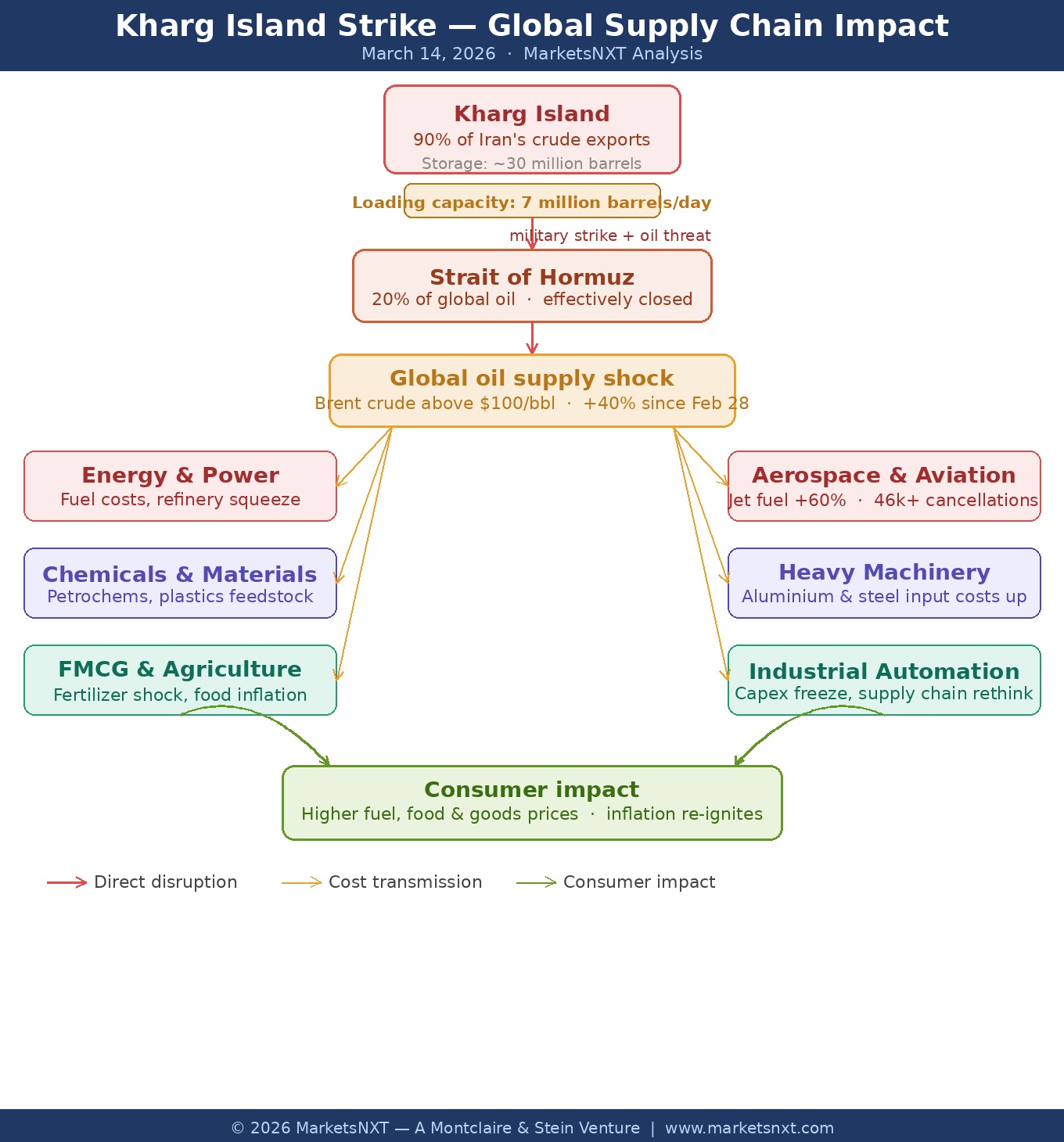
Kharg Island handles approximately 90% of Iran's total crude exports. Its loading terminals have a peak capacity of 7 million barrels per day, though current exports under war conditions run between 1.1 and 1.5 million barrels daily. Storage capacity on the island sits at roughly 30 million barrels, with approximately 18 million barrels of crude currently held there, according to data from trade analytics firm Kpler. Iran pumps around 3.3 million barrels of crude per day — roughly 4.5% of global supply — and the overwhelming majority of it moves through this one small island before transiting the Strait of Hormuz.
No other major oil-producing nation concentrates this much of its export capacity in a single location. Saudi Arabia, Iraq, Kuwait, and the UAE all maintain distributed infrastructure. Iran does not. As JP Morgan noted in a research note this week, Kharg is "a cornerstone of Iran's economy and a major source of revenue for the Iranian Revolutionary Guard." A CIA assessment from 1984 — still quoted by analysts today — described the island's facilities as "the most vital in Iran's oil system, and their continued operation is essential to Iran's economic well-being."
That assessment has only grown more accurate with time.
Immediate Market Impact
Brent crude closed above $100 per barrel for the second consecutive day on Friday — a threshold it had not breached in nearly two years. Oil prices have surged more than 40% since the conflict began on February 28. The strikes on Kharg, even without touching the oil infrastructure, sent a signal to energy markets that the economic endgame of this conflict is now in play.
Former US Army Brigadier General Mark Kimmitt told CNN that the US has "raised the stakes considerably" — moving beyond a military campaign against Iran's armed forces into territory that explicitly threatens the country's economic survival. "It means we have gone from 'take out the military, take out the regime' to trying to take out the economic lifeblood of this country, potentially," Kimmitt said.
Neil Quilliam of the Chatham House think tank had previously warned that a strike on Kharg's oil facilities could push prices to $150 a barrel. Muyu Xu, senior crude oil analyst at Kpler, told CNN that if Kharg's oil infrastructure were destroyed, it could take Iran "months, if not more than a year, to rebuild" — a timeline complicated by Western sanctions that restrict Tehran's access to financing and the technology required for reconstruction.
How This Flows Through Global Production and Consumption
The direct supply effect of destroying Kharg's oil infrastructure — a scenario not yet realised but now credibly threatened — would be a near-total removal of Iranian crude from global markets. Iran's 1.1 to 1.5 million barrels per day of current exports, added to the existing Strait of Hormuz disruption that has already suspended roughly 15 to 20 million barrels of daily regional flows, would create a supply hole that no combination of strategic reserve releases and alternative producers could fill quickly.
For industrial operators, the transmission mechanism is direct and layered. Petrochemical feedstocks, plastics, synthetic fibres, fertilizer inputs, and industrial gases — all priced off the same energy complex — face further cost escalation. Manufacturing sectors that were already recalibrating input cost assumptions in a $90-oil environment must now scenario-plan for $120 or $150.
For consumers, the pass-through timeline is well understood: energy prices today become goods prices in 4 to 8 weeks, food prices in 2 to 3 months, and generalised inflation over the subsequent two quarters. Patrick Penfield of Syracuse University's supply chain programme has said it plainly: "When fuel prices go up, everything starts to slow down." Consumers across Asia — which imports the overwhelming majority of its oil from the Gulf — are already absorbing the first wave. The second wave, if Kharg's oil infrastructure is struck, would be of a materially different magnitude.
Has Kharg Weakened Iran's Resolve?
The strategic logic behind striking Kharg's military installations — while conspicuously sparing the oil infrastructure — is coercive rather than destructive. Trump is holding the island's economic function hostage to compel Iran to reopen the Strait of Hormuz.
Whether it works depends on a regime calculus that is difficult to read from the outside. Iran's new Supreme Leader had, before the strikes, declared the Strait must remain closed as "a tool to pressure the enemy." Iranian Parliament Speaker Mohammad Baqer Qalibaf had warned that Iran would "abandon all restraint" if there was any US aggression against Iranian islands in the Gulf. The strikes on Kharg's military installations — technically not oil infrastructure — appear designed to stay just inside that red line while making the next step unmistakable.
There are early signals of potential movement. A senior Iranian official told CNN that Tehran is considering allowing some vessels through the Strait, provided cargo is traded in Chinese yuan. That is a negotiating position, not a concession — but it suggests Tehran is not entirely indifferent to an exit ramp.
Secretary of Defense Pete Hegseth said this week that Iran's missile and drone launches have been "reduced sharply," and that Iran's new supreme leader is "wounded and likely disfigured." VP JD Vance confirmed: "We know that he's hurt. We don't know exactly how bad, but we know that he's hurt." A leadership that is physically degraded, economically isolated, and now watching its most valuable economic asset come under direct military threat is a leadership under existential pressure.
The Retaliation Risk
This is where the analysis must be honest about the danger.
Iran has already struck oil storage infrastructure in Bahrain and Oman. The IRGC has explicitly threatened to set the region's oil and gas infrastructure "on fire" if Iranian energy sites are attacked. Al Jazeera's correspondent in Tehran described this threat as "a card Iran is keeping" — implying it is deliberate, calculated deterrence rather than impulsive posturing.
If the US strikes Kharg's oil infrastructure — or if Iran concludes it is coming — the rational retaliation calculus points toward Saudi Aramco's export terminals, UAE pipeline infrastructure, Qatari LNG facilities, and intensified Strait of Hormuz mining. Any one of these would be a severe escalation. All of them together would constitute a regional energy catastrophe.
The asymmetry is what makes Iran's position particularly dangerous at this moment. A regime under existential threat, with degraded leadership, diminished military capacity, and its economic lifeline in the crosshairs, is a regime that may calculate — rationally or desperately — that escalating toward regional energy infrastructure is preferable to a passive capitulation that ends the regime itself.
MarketsNXT Analyst View
The strikes on Kharg's military installations represent a deliberate strategic step designed to maximise coercive pressure on Tehran without yet triggering the full energy market shock that oil infrastructure destruction would cause. Trump's public threat to "immediately reconsider" sparing the oil facilities is a negotiating tactic — but it is a tactic that has now materially shortened the distance between the current situation and an oil price shock of genuinely historic proportions.
For clients tracking energy, chemicals, aerospace, and industrial supply chains, the key variable to monitor over the next 72 hours is whether Iran signals meaningful movement on Strait of Hormuz access. If it does, the coercive strategy will have worked, and markets will price a partial relief scenario. If it does not — or if Iran retaliates against Gulf energy infrastructure — the frameworks that governed market analysis before March 14, 2026 will need to be rebuilt from scratch.
MarketsNXT is tracking developments across all affected sectors. Country-level and sector-specific reports for the Gulf, Asia-Pacific, and European markets are available for clients needing structured intelligence during this period of acute uncertainty.
The views expressed represent MarketsNXT's independent market analysis and do not constitute financial or investment advice.
Markus Weidemann leads Middle East market intelligence at MarketsNXT, with over 14 years tracking energy geopolitics, industrial supply chains, and commodity market dynamics across the Gulf region. His analysis draws on the institutional research frameworks developed through the Montclaire & Stein legacy.